Leave Your Message
Choosing Grease Manufacturing Raw Materials is a technical decision that affects consistency, equipment protection, operating temperature, and product life. A reliable formulation begins with the application, not with the cheapest available ingredient. The grease must match load, speed, temperature, water exposure, storage conditions, and relubrication intervals. Small details matter. A bearing operating near a dusty furnace needs different protection from a slow gearbox in a humid plant.
Dr. Raj Shah, a tribologist and lubricant testing specialist, states, “Lubrication is a system, not simply a product.” This principle deserves attention. Base oils influence viscosity and low-temperature flow. Thickeners control structure, release, and mechanical stability. Additives support oxidation resistance, corrosion protection, extreme-pressure performance, or wear control. However, additives cannot rescue incompatible raw materials or poor processing. That assumption can fail.
Experienced manufacturers also examine supplier consistency, certificate data, contamination risks, traceability, and storage behavior. A calcium sulfonate complex grease may offer strong water resistance, while a lithium complex system may provide familiar processing and broad industrial use. Neither choice is automatically superior. It depends on evidence.
Testing should include worked penetration, dropping point, oil separation, corrosion behavior, and application-specific performance. Pilot batches are essential. Laboratory results alone can mislead. Real equipment reveals vibration, noise, leakage, and residue patterns that a test cup cannot fully reproduce. This guide explains how to compare each raw material, question supplier claims, and build a practical selection process. Some judgments remain difficult. That is normal. Good formulation combines data, field experience, and careful reconsideration.
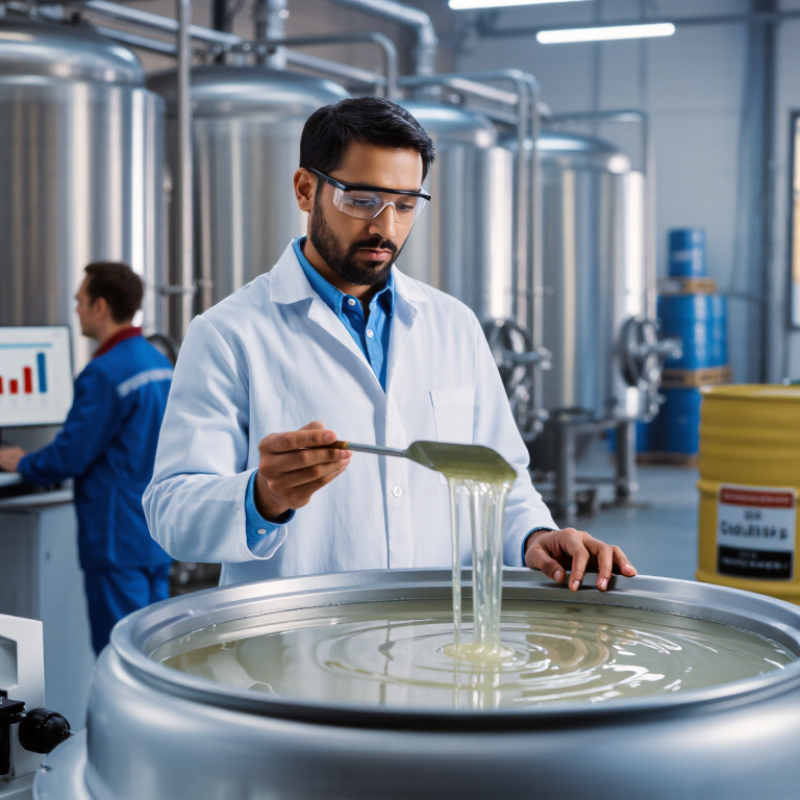
How to Choose Grease Manufacturing Raw Materials?
Understanding the Role of Raw Materials in Grease Manufacturing
Choosing grease manufacturing raw materials starts with understanding each material’s function. Grease is not simply oil mixed with a thickener. Base oil controls flow, film strength, and low-temperature behavior. The thickener creates the semi-solid structure. Additives help resist oxidation, wear, rust, and water washout. These roles overlap. A small change can affect the entire product.
During formulation, match raw materials to the equipment and service conditions. A heavily loaded bearing may need strong film formation and extreme-pressure protection. An electric motor bearing may require low bleed and stable torque. Temperature matters too. Test samples under operating and accelerated conditions. Measure penetration, dropping point, oil separation, water resistance, and worked stability. A smooth-looking grease can still fail after prolonged shear.
Reliable selection also requires strict incoming material control. Review specifications, certificates of analysis, batch traceability, and storage conditions. Check compatibility before combining thickeners or additive packages. Some materials appear interchangeable, but their chemistry may react differently to heat or moisture. That assumption needs testing. Cost pressure can encourage substitutions. I have seen this create inconsistent texture and field performance. Even a well-designed formula may need revision after pilot production. Small errors in mixing temperature, ingredient order, or moisture control can become serious failures.
| Raw Material Category | Common Material Types | Primary Role in Grease | Typical Formulation Range | Key Selection Factors | Typical Performance Contribution |
|---|---|---|---|---|---|
| Base Oil | Mineral oil, polyalphaolefin, ester, polyalkylene glycol, silicone oil | Provides the main lubricating film and carries the thickener and additives. | Approximately 70–95% by mass | Viscosity, temperature range, oxidation stability, compatibility, cost, and biodegradability | Controls low-temperature pumpability, film strength, evaporation, and high-temperature life. |
| Simple Soap Thickener | Lithium soap, calcium soap, sodium soap | Forms the semi-solid structure that holds the base oil in place. | Approximately 5–15% by mass | Water resistance, dropping point, shear stability, manufacturing temperature, and equipment requirements | Lithium soap offers a balanced general-purpose profile; calcium soap provides strong water resistance but lower temperature capability; sodium soap generally has poor water resistance. |
| Complex Soap Thickener | Lithium complex, calcium sulfonate complex, aluminum complex | Creates a reinforced thickener network for higher operating temperatures and load conditions. | Approximately 8–25% by mass | Dropping point, mechanical stability, water resistance, load-carrying demand, and processing complexity | Usually improves high-temperature resistance and structural stability compared with many simple-soap greases. |
| Non-Soap Thickener | Polyurea, organophilic clay, silica, polytetrafluoroethylene | Provides a thickener structure without relying on metallic soap chemistry. | Approximately 5–30% by mass, depending on type | Thermal stability, shear resistance, compatibility, dispersion quality, and processing temperature | Can provide excellent high-temperature life or chemical resistance, but compatibility with other grease types must be verified. |
| Performance Additives | Antioxidants, corrosion inhibitors, rust preventives, extreme-pressure and antiwear agents | Protects the grease, metal surfaces, and lubricated components during service. | Approximately 0.1–10% by mass, depending on the additive package | Operating load, temperature, moisture, metal compatibility, regulatory restrictions, and additive interactions | Improves oxidation life, rust protection, wear control, and resistance to shock or boundary lubrication. |
| Solid Lubricants | Molybdenum disulfide, graphite, boron nitride, polytetrafluoroethylene | Reduces friction and wear when fluid-film lubrication is insufficient. | Approximately 1–10% by mass when required | Load, speed, temperature, electrical requirements, particle size, and component clearance | Supports boundary lubrication and heavy-load performance, but may be unsuitable for rolling bearings or fine clearances. |
| Viscosity Modifier | Polymeric viscosity modifiers and selected high-viscosity fluids | Adjusts the flow and film-forming behavior across the operating temperature range. | Usually 0–10% by mass or achieved through base-oil selection | Shear stability, low-temperature behavior, viscosity-temperature response, and compatibility | Helps balance start-up flow with high-temperature film thickness, although excessive polymer content may reduce shear stability. |
| Adhesion and Tackifying Components | High-molecular-weight polymers and tackifying resins | Improves retention on exposed, vertical, or slowly moving surfaces. | Approximately 0.1–5% by mass | Stringiness, shear resistance, dust attraction, pumpability, and application method | Reduces sling-off and wash-off, but excessive tackiness can hinder dispensing and attract contaminants. |
| Colorants and Tracers | Oil-soluble dyes and compatible pigments | Provides visual identification and supports product segregation during handling. | Normally below 1% by mass | Heat stability, light stability, staining tendency, and compatibility with the formulation | Primarily affects appearance and identification rather than core lubrication performance. |
| Process Aids | Dispersants, defoamers, release aids, and controlled amounts of solvent or diluent | Supports mixing, dispersion, deaeration, texture control, and consistent manufacturing. | Typically below 3% by mass, where used | Volatility, worker safety, residue, environmental requirements, and effect on final consistency | Improves batch uniformity and process control without becoming a dominant component of the finished grease. |