10 Essential Tips for Choosing Nonionic Surfactants for Your Formulations?
When formulating products, the choice of a Nonionic Surfactant is crucial. These surfactants offer unique advantages, including mildness and compatibility with various ingredients. They work effectively in the presence of hard water, making them versatile for different applications. However, navigating the selection process can be challenging.
Understanding the properties of Nonionic Surfactants is essential for achieving desired outcomes. Characteristics like hydrophilicity, molecular weight, and HLB value significantly impact your formulation's performance. Each parameter must be carefully considered to avoid suboptimal results. Sometimes, the perfect surfactant may not exist, leading to unforeseen challenges in stability or performance.
Trial and error often play a role in formulation development. Different Nonionic Surfactants can yield varying results even in small changes. Documenting these outcomes is critical for future reference. Embracing the complexity of surfactant selection can lead to innovative solutions. Enhancing your formulations often requires a deeper exploration of available options.

Understanding Nonionic Surfactants: Definitions and Characteristics
Nonionic surfactants are crucial in many formulations due to their versatility and effectiveness. Defined by their lack of ionic charge, these surfactants interact well with various ingredients. They typically exhibit good stability across a wide range of pH levels and temperatures. This makes them suitable for diverse applications, from detergents to personal care products. According to a report by Market Research Future, the nonionic surfactants market is expected to grow significantly, driven by demand in household and industrial sectors.
The characteristics of nonionic surfactants include low toxicity and biodegradability. They tend to form stable emulsions and foams, which is essential in many formulations. However, one should consider potential drawbacks. Their performance may not match that of ionic surfactants in specific conditions. For instance, in very hard water, nonionic surfactants can be less effective. Manufacturers must analyze their formulations closely. Balancing efficiency and environmental impact is vital. Data indicate that while nonionic surfactants constitute a sizable market share, understanding their limitations is equally important.
Identifying Key Properties for Effective Formulations
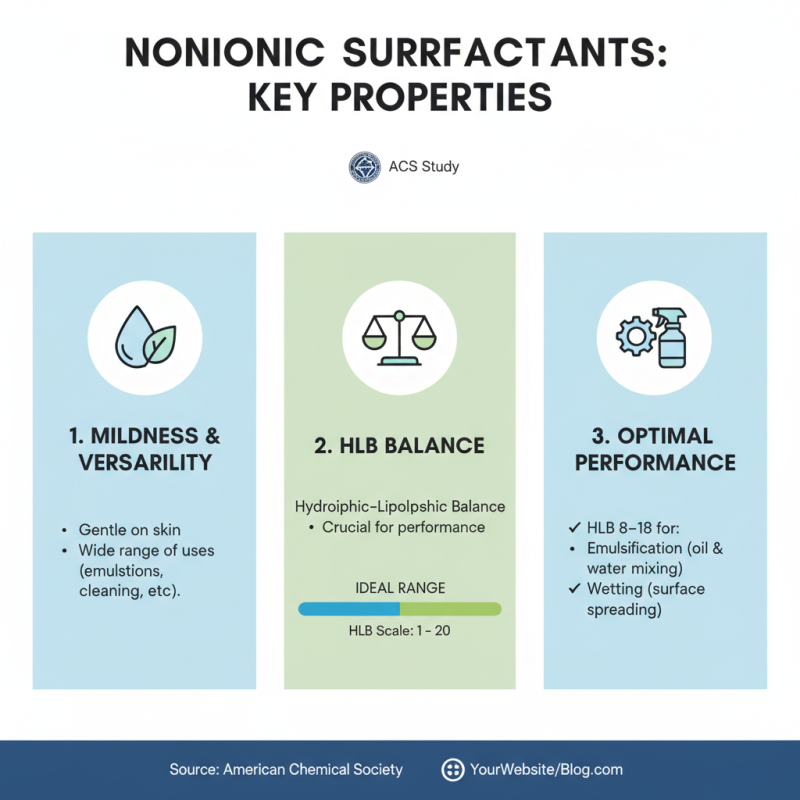
When selecting nonionic surfactants for your formulations, understanding key properties is crucial. These surfactants are often favored for their mildness and versatility. A study by the American Chemical Society highlights that optimal hydrophilic-lipophilic balance (HLB) plays a pivotal role in determining emulsification and wetting performance. Surfactants with an HLB value between 8 and 18 are generally ideal for various applications.
The solubility of nonionic surfactants in water can influence their efficacy. Research indicates that surfactants with higher molecular weights tend to provide better stability in emulsions. However, this stability can come at the cost of solubility. This trade-off may lead to trial and error in formulations. For example, if a surfactant is not sufficiently soluble, it may precipitate or form undesirable layers.
Another critical aspect is the cloud point, which defines the temperature at which a surfactant loses effectiveness. Products with high cloud points are often more suitable for high-temperature applications. Yet, achieving the right cloud point is challenging. Relying solely on theoretical calculations may not yield the desired outcomes in real-world conditions. Thus, empirical testing is necessary to validate these properties in formulations. Understanding these nuances will ultimately result in more effective products.
Evaluating Compatibility with Other Ingredients
When evaluating nonionic surfactants, compatibility with other ingredients is critical. Many formulators overlook this aspect, leading to unexpected stability issues. For instance, a recent industry report indicated that over 30% of formulation failures are attributed to incompatibility between surfactants and other components.
Understanding the chemistry behind nonionic surfactants helps in selecting compatible ingredients. These surfactants usually exhibit lower toxicity and are mild on skin. However, they can still interact unfavorably with certain ionic or cationic compounds. For example, some nonionic surfactants may destabilize when combined with high concentrations of electrolytes. This can be a common pitfall for those who may not conduct thorough pre-formulation tests.
Moreover, the differences in molecular weight and hydrophilic-lipophilic balance (HLB) can significantly influence compatibility. Formulators should consider these factors during the selection process. Even minor adjustments in formulation ratios can lead to major differences in product stability. As emphasized by industry experts, a comprehensive compatibility study should be a mandatory step in product development rather than an afterthought.
Assessing Environmental and Safety Considerations
When selecting nonionic surfactants, assessing environmental and safety considerations is crucial. Nonionic surfactants are often favored for their mildness and biodegradability. Reports indicate that around 70% of nonionic surfactants can be broken down in natural systems, making them an ideal choice for eco-conscious formulations. However, not all surfactants are created equal. Some may still pose risks to aquatic life, which is an essential factor to consider.
Consumer safety is another major focus. Studies have shown that many nonionic surfactants can be irritants. Products containing surfactants with higher cloud points can also have limited efficacy in different temperatures. Manufacturers must ensure their formulations remain safe during various applications. Evaluating specific toxicity data on individual surfactants can provide clarity. Many surfactants may not illustrate immediate harmful effects but could accumulate in ecosystems over time.
Furthermore, labeling requirements must adhere to local regulations. Some manufacturers overlook this critical detail. Transparency about the surfactants used fosters trust with consumers. While it may seem tedious, proper labeling and environmental assessments align products with modern sustainability goals. Constantly revisiting these factors is necessary and promotes responsible formulation practices.
Environmental and Safety Considerations for Nonionic Surfactants
Determining Cost-Effectiveness and Availability
When selecting nonionic surfactants, cost-effectiveness and availability are vital. Recent market analyses reveal that the global surfactant market is expected to reach approximately $45 billion by 2025, with nonionic surfactants representing a significant share. Knowing this helps in making informed choices in formulation development.
Many nonionic surfactants are sourced from renewable raw materials. This can lower costs and improve sustainability. However, some suppliers may face supply chain issues. Availability can fluctuate, impacting production timelines. A surfactant that is cost-efficient today may not remain so in the future.
It is essential to gather data on pricing trends and procurement options. Some nonionic surfactants can be more expensive as they undergo stricter quality testing. Evaluating different suppliers helps identify options that align with budget constraints. If a supplier is hard to reach or inconsistent, that can lead to hesitation in formulation processes. Balancing cost with performance and reliability is often a challenging task.